
By Michael Castle, Castle Bison Company
Originally published in January 2025 RMBA Newsletter
My wife Tiffany and I own the Castle Bison Company in Carr, Colorado. Along with running things here at CBCo., I am also the president of the U.S. Tumbleweed Ranchers Association (TWRA). I was asked to share a little bit about Operation Enduring Tumble (OET) and give readers some insight into the tactics and strategies used to combat this year’s invasion.
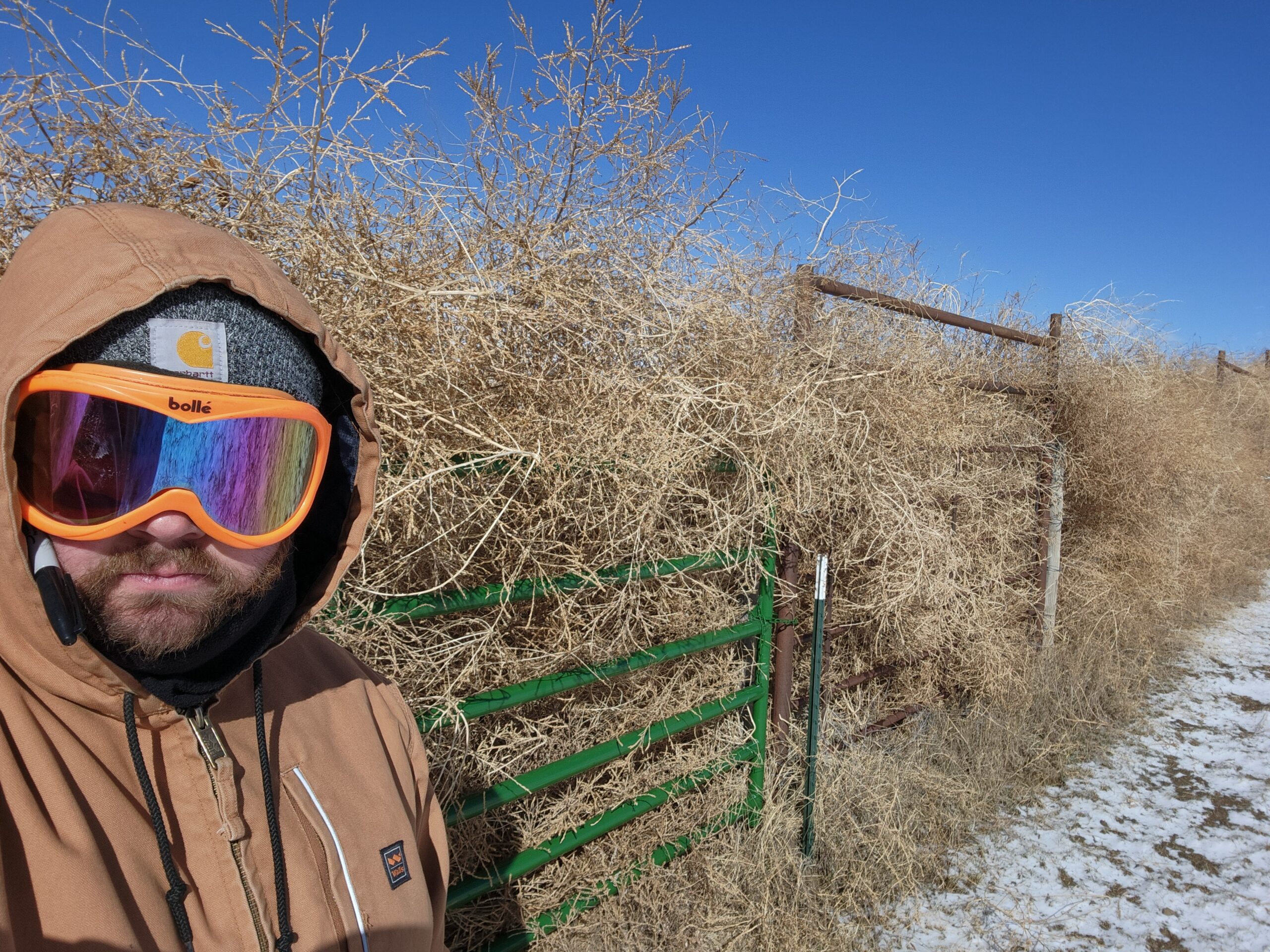
Michael Castle next to his tumbleweed-infested fence.
Just kidding – the TWRA and OET aren’t really a thing. But the great tumbleweed war of ‘24 really is an ongoing battle and holy heck it’s taken a toll on us!
Lets jump back to 2023 for a moment.
Our ranch was blessed with what seemed like record breaking rains. We had beautiful, thick, lush, green grass galore all the way through summer. It was incredible! But as we all know, when you have enough moisture to grow grass, you have more than enough to grow weeds. Our pastures seemed to be in pretty good health and our weeds were minimal. I can’t say the same for the thousands of acres directly west of us though.
So moving out of summer, through fall, and into 2024’s winter, things dried up and we saw the typical seasonal changes. If you don’t know where Carr, Colorado is, just pretend we’re in south Cheyenne, Wyoming and you’ll be close enough. We’re literally the last exit in CO headed north into WY. So being in south Cheyenne, we get those beautiful breezes the area is known for. And by a beautiful breeze, I’m talking about soul sucking, heart breaking, hurricane like wind. Our seasonal winds will get ripping – it’s brutal.
February 24th, 2024, while I was out of state for a funeral and my wife Tiffany was at home with our four week old son, the wind picked up and began it’s reign of terror. We had constant winds in the 60 to 70 mph range for three days straight. That wind must have blown every bit of Russian Thistle (the common tumbleweed out here) from here to California straight onto our fences and then through our fences. Yeah – the tumbleweed takeover put my fences on the ground. We run 6 strands of high tensile electric with the top wire at six feet. I thought we had built a pretty good bison fence – but it seems I built an even better tumbleweed strainer.
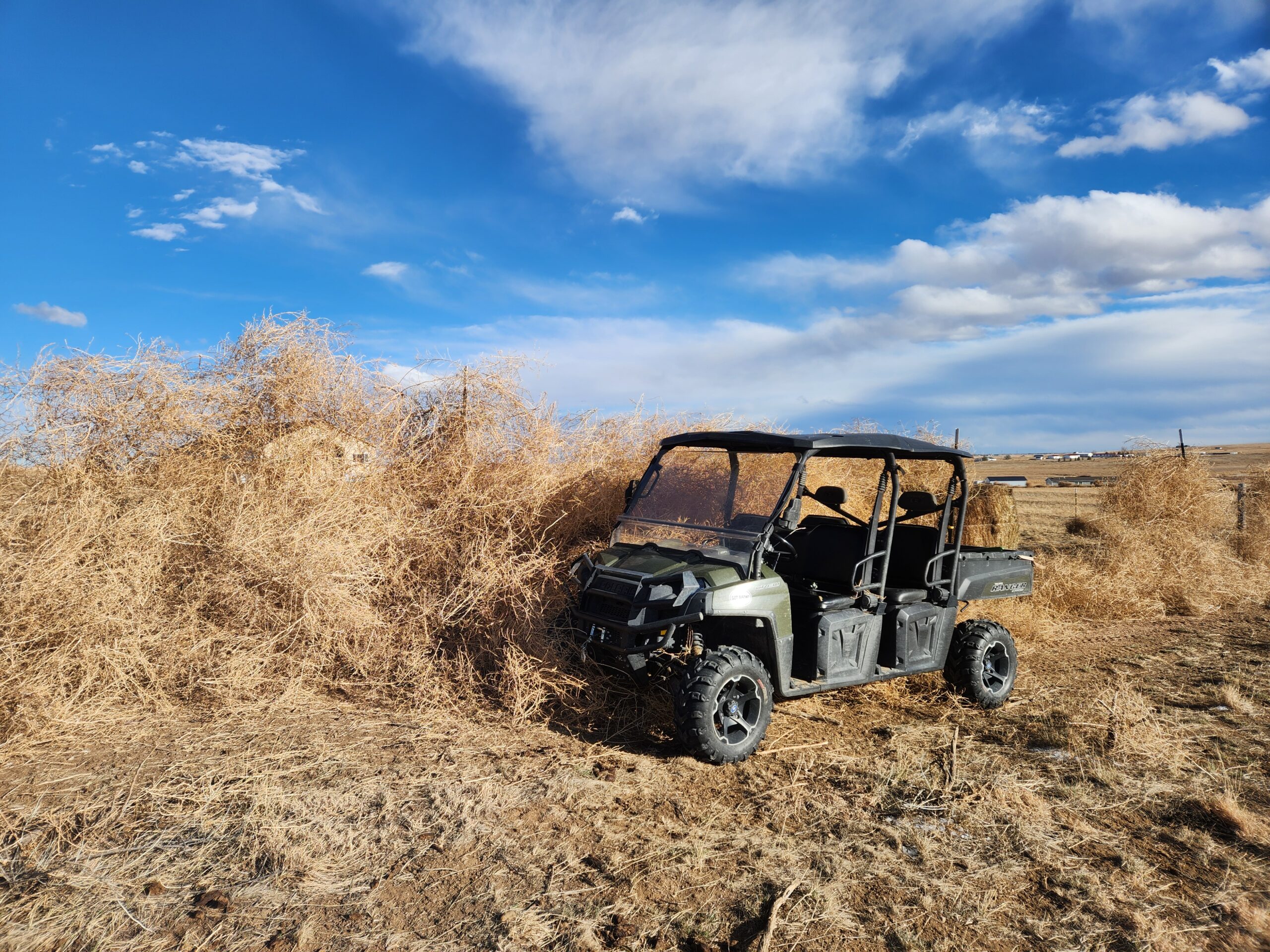
Tumbleweed tower compared to the size of a standard side-by-side.
The fault of bison fence here is the height – those top two wires at about five and six feet catches way more tumble than typical shorter cattle fence. The added height equates to added leverage and with a wall of tumbleweed acting like a ship’s sail for three days at 60+ mph, it couldn’t take the strain. I got a call from a crying wife (holding a 3 week old and recovering from a c-section), panicked about what to do. I’m not used to feeling helpless but I was across the country and couldn’t do anything – other than make phone calls. So we called in the calvary (huge shout out to Greg and Tami Nott at Memphis Ranch!) and in quick order, we had assembled a small militia to combat the invasion. They managed to get our entire herd moved into an interior holding pen, reinforce that holding pen, and patch things up just enough to get us through until I was home to rebuild.
When I got home, I had about two miles of fence either on the ground, or barely standing. It was devastating. I had never seen this before, and in talking to neighbors, they said that in the 40+ years they had been here, they hadn’t either. The whole region was in shambles.
With a lot of hard work, long days, and help from friends, we were able to get the fence kind of, sort of, for the most part, put back up and functional. It was the kind of “ranch functional” we are all well acquainted with. The kind of functional we get when desperate times meet desperate measures and will be “good enough for now” until we can do it the right way later.
After a week straight of sun up to sun down fencing, I got the herd out of the pen and back out to pasture. It was great! At the end of that last day, I took a much needed shower, threw on my “nice jeans” and ran down to Fort Collins to have dinner at the RMBA spring conference. But while we sat there enjoying a nice meal and great company, the wind picked up again. When I got home I saw all of the fence I had just cleared and fixed was littered with tumbleweeds again – but fortunately the fence was still standing – for now.
Little by little, one day at a time, one post at a time, I kept clearin’ n fixin’. Things were looking up until April 6th. A little more than a month after mother nature’s first beat down, she sent a second – and with a new kind of wrath. Wind gusts that night were recorded up to 93 mph. Yeah – 93 mph! I got home that evening and went out in the dark to check our fence lines. Our west line, the one that takes the brunt of the wind and collects most of the tumbleweeds from the east, was flat on the ground and pretty much didn’t exist anymore. There was nothing I could do for the fence, and the herd wouldn’t move for me in those conditions under nightfall. There was nothing to be done but go to bed and pray the herd would stay put. Needless to say, I didn’t sleep well that night.
Assessment
I woke up early and went to check the herd. Praise God – they were right where I left ‘em! Tiffany has a way with our lead cow and with her magic shake of a cake bucket, she got that stubborn old girl to follow her into the pen again and the herd followed suit. Hallelujah – crisis averted – the herd was contained. Next I hit the ground to sort through the damage. One thing I noticed about the fence throughout all of this was that every single component and piece of hardware had failed somewhere. Ratchet strainers, spring tensioners, wire crimps, high-strain insulators, t-post clips, t-post insulators, t-posts themselves, utility pole line posts… every component failed in one spot or another – except the wire. I didn’t have a single piece of broken high tensile wire from the wind and weeds. I was pretty surprised by that.
Strategy
Dig out and rebuild. I can’t tell you how long it took to clear the tumbleweeds because 11 months later – we’re still not finished. We just had to prioritize which sections of fence were most important and start clearing. But how? I would love to tell you that I called a few friends with water trucks and just lit a match – but remember those lovely breezes I mentioned? Yeah – I don’t want to be the guy who sets the whole wide wild west on fire. Plus, burning those weeds on the fence line would melt the insulators and leave the HT wire brittle. We tried pulling the weeds off with various skid steer attachments but the weeds were so hard packed and rats nested around the wires that pulling with equipment ended up breaking the wire (the 200k psi wire I just mentioned was nearly indestructible). We tried every creative technique we could come up with but at the end of the day, it was good ol ranch labor that did it. We just had to pull em by hand. Now I’ve heard legend of a unicorn like tractor PTO implement with paddles that will clear the fences, but I could never find one in real life. It seems to exist only on the internet and in my dreams. (But if you have one I can borrow – let me know!)
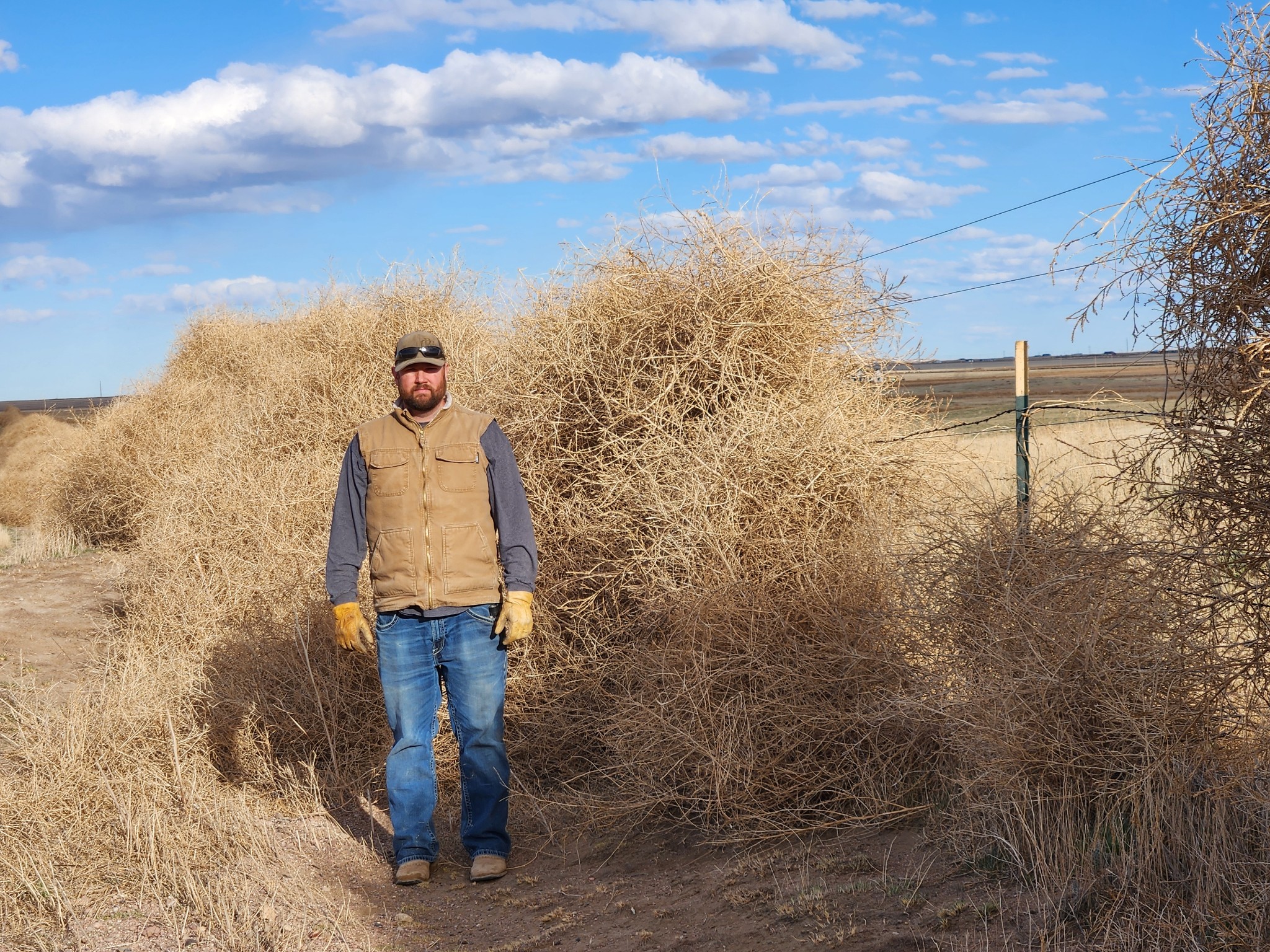
Michael Castle standing next to a tower of tumbleweeds hiding his fence.
Rebuild
We found it was better to just start over -rip everything out and start new. That was a painful realization but it is what it is. We found that trying to bend t-posts back up right just resulted in them snapping at the base where they had been bent in the first place. (straightening a slight bend is one thing, but we had near 90 degree angles on these suckers). I kept the design pretty much the same as it had been for interior fences, but added more line posts where I could. I did however change things up for our perimeter lines that run north / south because our harshest winds hit us blowing from west to east. I’ve got a plan to replace those lines over the next few years with pipe fence. To start, I bought as much 2 ⅜ oil pipe as I could afford (since all of us ranchers just have tons of e.xtra cash on hand right?) and cut it into 10’ posts. I sank those posts on 20’ intervals and put those six HT wires back up. That oil pipe is a big step up in strength and rigidity from t-posts. Next year I plan to get more pipe and go back to those same lines and put posts in between what’s there which will leave me with 10’ spacing. The year after that, I’ll get even more pipe and start welding out a top rail and eventually lower rails along our most vulnerable areas and our road frontage.
Pipe fence might sound overkill. And maybe it is. But We’re a small operation with several neighbors around our place. Some of those neighbors aren’t keen on bison so I’ve gotta do my best to keep the herd where they’re supposed to be. In addition to that, and more importantly, I’ve got a day job that is about an hour and a half commute away and given the nature of my work, I can’t just up and leave at the drop of a hat. So it’s important to me to have confidence in my fence to keep the herd in. And while I have great confidence in the original 6 wire HT design to contain the herd (even though we all know those animals can and will do whatever they want) the collapse and crumble of that design under the pressure of wind and weeds has me needing something more stout and I think pipe is the ticket.
Throughout all of this, people gave us all kinds of advice and suggestions, but this is what ended up working for us. I’m a big believer that 2+2, 3+1, 5-1, and 1+1+1+1, all equal 4. What I mean by that is there are a million ways to get a job done and nothing in bison stewardship is a one size fits all solution. Just work hard, trust God and take it one day at a time.